Astrocartography
Astrocartography shows where on Earth your natal planets were on the angles at the moment of birth. The idea is that a planet's theme gets louder in those places. The “Astrocartography” section is at the bottom of the page.
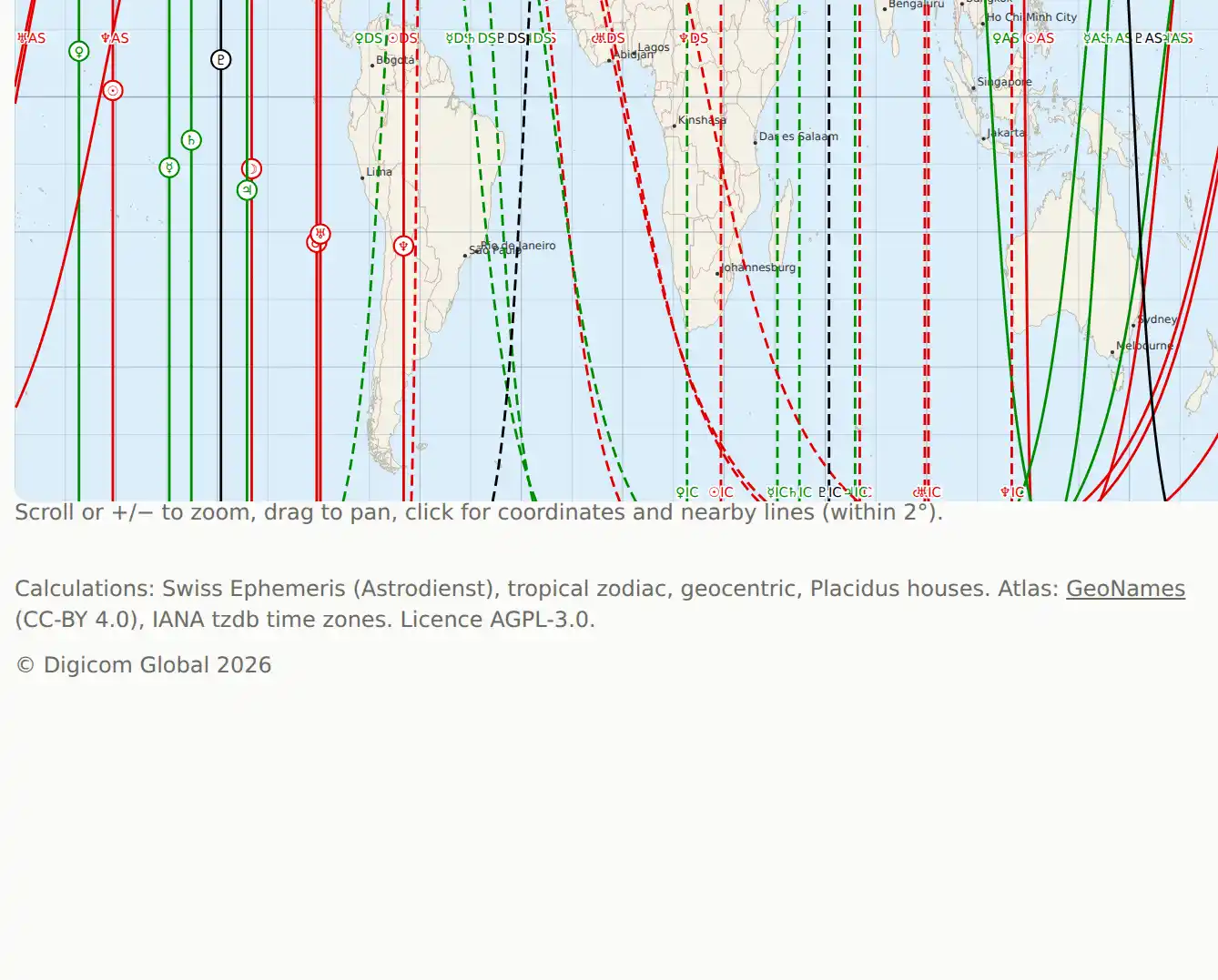
Reading the map
- Solid lines: the planet on the MC (culminating) or ASC (rising).
- Dashed lines: on the IC or DSC (setting).
- A circle with a glyph: the planet's zenith, where it was straight overhead.
- The red dot: the birthplace.
The mouse wheel or the “+” and “−” buttons zoom, dragging pans, and “whole world” resets the view. Tap a spot and its coordinates appear under the map, along with lines passing nearby (within 2°).
Switches
| Switch | What it does |
|---|---|
| In Mundo / In Zodiaco | Lines from the planet's real position in the sky (with its latitude) or from its projection on the ecliptic |
| all points (incl. fictitious) | Adds lines for the node, Lilith, Chiron and fictitious points |
| prime vertical | Dash-dot lines: the planet on the prime vertical (due east or west) |
| aspects to angles (* □ △) | Dots where a planet is sextile, square or trine an angle |
| Local Space | Great circles from the birthplace along each planet's azimuth |
| parans Pro | Latitudes where the Sun or Moon is on an angle at the same time as another planet |
| geodetic | Geodetic grid: “Sepharial (longitude)”, “Sepharial (right ascension)”, “Johndro” |
With a geodetic grid on, the map shows MC verticals for the twelve signs, and the geodetic chart of the birthplace appears under the map. Tap another spot to see its geodetic chart.
Parans Pro
The “Parans” block under the map lists pairs of points that are on angles at the same time (rising, culminating, setting, anti-culminating) at the birth latitude, with a 1° latitude orb. “with stars” adds stars brighter than magnitude 2.
Related pages
Relocation: what changes in your chart in a new city.